Inside the Craft: How Libbey's One-Piece Forming Process Creates Glassware That Lasts
A Legacy of Firsts
Libbey's story began in 1818, when the New England Glass Company was founded in East Cambridge, Massachusetts. In 1888, Edward Drummond Libbey moved the operation to Toledo, Ohio—a city blessed with abundant natural gas, high-quality sand, and rail connections that made it ideal for glassmaking. By 1892, the company was officially renamed the Libbey Glass Company, and Toledo earned its enduring nickname: "The Glass City."
From the very beginning, Libbey has been a pioneer. The company was the first to automatically produce lightbulbs, the first to develop machine-blown glass, and—most importantly for our story—the first to create one-piece press-and-blow stemware. In 1970, Libbey developed and patented technology to produce seamless stemware, a breakthrough that dramatically reduced breakage in commercial settings and cemented the brand as the top choice for hospitality clients worldwide.
But what exactly does "one-piece forming" mean, and why does it matter?
---
The Problem with Seams
Traditional stemware is often made in two pieces: the bowl and the stem are formed separately, then joined using heat. This creates a seam—a structural weak point where the bowl meets the stem. Under the stress of daily commercial use—constant washing, stacking, and handling—that seam is where chips begin, cracks form, and glasses eventually fail.
Libbey's one-piece press-and-blow process eliminates that vulnerability entirely.
---
From Sand to Molten Glass
Every piece of Libbey glass starts with a carefully balanced recipe of quartz sand, soda ash, and limestone—the classic trio of soda-lime glass. These materials are precisely weighed and mixed according to Libbey's proprietary formulas, then fed into a furnace and superheated to temperatures approaching 1,700°C (about 3,100°F). At these extreme temperatures, the raw materials melt into a homogeneous, bubble-free liquid glass—a viscous, glowing mass that looks like liquid honey on fire.
Libbey has also invested heavily in sustainability. The company is retrofitting its Toledo facility with hybrid electric melting furnaces that combine oxygen-fuel technology with electric melting, reducing carbon dioxide emissions by up to 60 percent.
---
The One-Piece Press-and-Blow Process
Once the glass is molten, it's time to shape it. For stemware and delicate pieces, Libbey uses its signature one-piece press-and-blow method.
Step 1: The Gob. A precise "gob"—a lump of molten glass—is dropped into a mold. The weight and temperature of this gob are carefully controlled to ensure consistency from piece to piece.
Step 2: Pressing. A plunger presses the gob into an initial shape within the mold, forming the rough outline of the bowl and the beginnings of the stem.
Step 3: Blowing. Compressed air is then introduced to blow the glass into its final form inside a second mold. But here's the critical difference: in Libbey's one-piece process, the bowl and stem are formed as a single, continuous unit. The glass flows seamlessly from bowl to stem to foot—no seam, no joint, no weak point.
Step 4: The Stretch. For stemware, the still-molten glass is stretched and drawn to create the slender, elegant stem—a process that requires extraordinary precision and timing. The result is a glass that is not only beautiful but structurally superior.
Libbey has invested over $100 million in its U.S. factories over the past decade, pioneering advanced manufacturing systems that include automated sandwich press-and-blow molding and laser measurement technology. The molds themselves require incredible precision, and Libbey's proprietary ClearFire™ glass formula—developed through nearly two years of research—enables the production of soda-lime glass with exceptional brilliance and 30 percent less iron content than conventional glass.
---
The Science of Strength: Annealing
Freshly formed glass is still extremely hot and filled with internal stresses—like a tightly coiled spring waiting to snap. Without careful treatment, it would crack or shatter at the slightest touch.
That's where annealing comes in. The glassware travels through a long, tunnel-like kiln called a lehr, where it is gradually reheated to a uniform temperature and then cooled down slowly and evenly. This controlled cooling releases internal stresses, transforming the fragile glass into a strong, stable product. Think of it as the glass equivalent of tempering steel—slow and patient, but absolutely essential.
For added durability in commercial settings, many Libbey products receive additional treatments. The DuraTuff process strengthens the upper third of the glass through a special thermal after-process, while the Safedge® Rim and Foot guarantee backs one-piece stemware against chipping—a testament to the confidence Libbey has in its one-piece construction.
---
Why One-Piece Matters
The difference between one-piece and two-piece glassware isn't just aesthetic. It's structural.
No seams, no weak points. In two-piece stemware, the joint between bowl and stem is where stress concentrates. One-piece construction eliminates this entirely, distributing stress evenly across the entire form.
Greater durability. One-piece glassware is significantly more resistant to breakage, especially in the high-stress environment of restaurants and bars where glasses are washed, stacked, and handled hundreds of times.
Better mouthfeel and aesthetics. The seamless flow from bowl to stem creates a continuous, elegant line. There's no visible joint, no ridge where the pieces meet—just a smooth, uninterrupted form.
Consistent performance. Libbey's dimensional consistency simplifies standardized pours behind the bar, ensuring that every glass performs exactly as expected, every time.
As one industry source puts it, Libbey's one-piece press-and-blow process "eliminates the seam between bowl and stem and delivers greater strength"—a simple statement that captures a profound engineering achievement.

---
Built for the Real World
The next time you hold a Libbey glass—whether it's a classic Gibraltar rock glass that revolutionized coffee culture or a beautifully designed stemware piece—remember that you're not just holding a glass. You're holding a piece of history, crafted to endure.
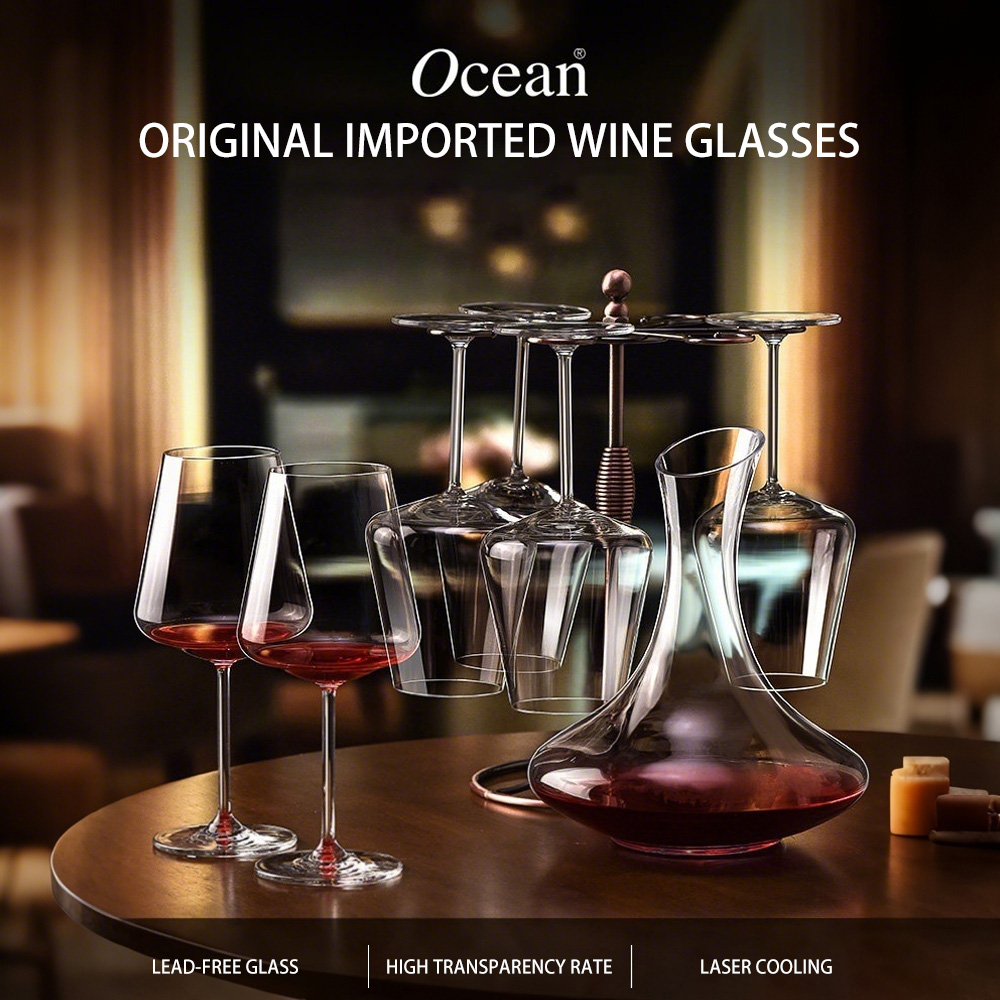
From a single gob of molten glass at 1,700°C to a seamless, durable piece on your table, every Libbey glass tells a story of precision, innovation, and a 200-year commitment to doing things the right way.
That's what one-piece forming really means. Not just a manufacturing technique—but a promise of quality that has been kept since 1818.


 From Flutes to Snifters: A Guide to the Many Types of Stemware
 Red Wine Glasses: A Guide to the Many Shapes and Why They Matter
 How to Identify a One-Piece Drawn Wine Glass: A Practical Guide for Wine Lovers


