The earliest human record of glass appears in a story written by the ancient Roman scholar Pliny.
The story is this: About 3,000 years ago, a European Phoenician merchant ship was loaded with the crystal mineral "natural soda" and sailed on the Belous River on the Mediterranean coast.
Due to low tide, the merchant ship ran aground midway.
So the crew had no choice but to abandon ship and land on the island.

When it was time to eat, they carried the cauldron to the island, brought in firewood, and used a few pieces of "natural soda" as a support for the cauldron to cook on the beach.
By the time the crew finished eating, the tide began to rise.
When they were about to pack up their things and board the ship to continue sailing, someone suddenly shouted: "Come and look, everyone, there are some crystal bright and sparkling things on the sand under the pot!"
The crew took these unexpectedly discovered shining objects to the ship and studied them carefully.
They found that these shiny things had some quartz sand and melted natural soda stuck to them.
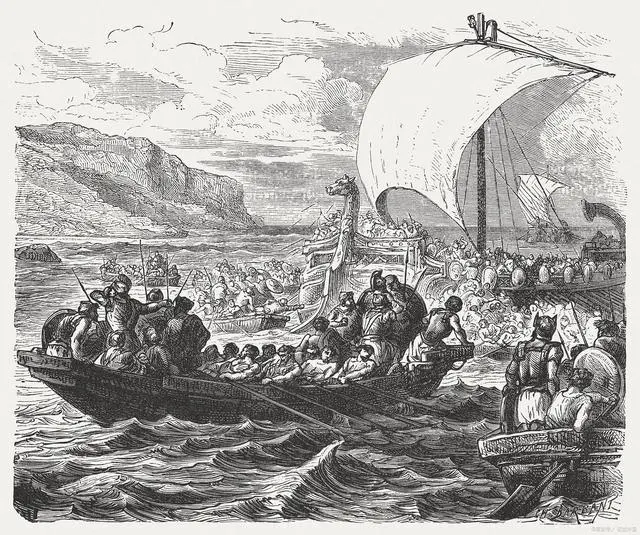
It turns out that the crew used natural soda to make pot supports when cooking, and under the action of flames, the natural soda reacted chemically with the quartz sand on the beach, eventually producing such a sparkling substance.
In this way, glass was created inadvertently.
Later, the Phoenicians mixed quartz sand and natural soda, melted it in a special furnace, and made glass balls for sale everywhere, making a fortune.
Around the 4th century, the ancient Romans began to apply glass to doors and windows.
By 1291, Italian glassmaking technology was very advanced.
In this way, Italian glass craftsmen were sent to an isolated island to produce glass. They were not allowed to leave the island during their lives.
It wasn't until 1688 that a man named Nave invented the process of making large pieces of glass. From then on, glass became a common item.
It can be seen that if you discover a new product and mass-produce it and apply it to our lives, you can create a lot of wealth.
It should be noted here that mass production and sales after discovery are the focus.

The people who discovered glass were Phoenician merchant ships. Selling and trading were their main business. If ordinary people discovered glass, they would not necessarily think that it could be sold as a commodity, and natural glass would not be manufactured in large quantities.
Then, the time for glass to become a familiar item to the public will have to be pushed back a long time.
As an aside, glass has developed into many special uses and has developed into many different varieties.


 From Flutes to Snifters: A Guide to the Many Types of Stemware
 Red Wine Glasses: A Guide to the Many Shapes and Why They Matter
 How to Identify a One-Piece Drawn Wine Glass: A Practical Guide for Wine Lovers


